
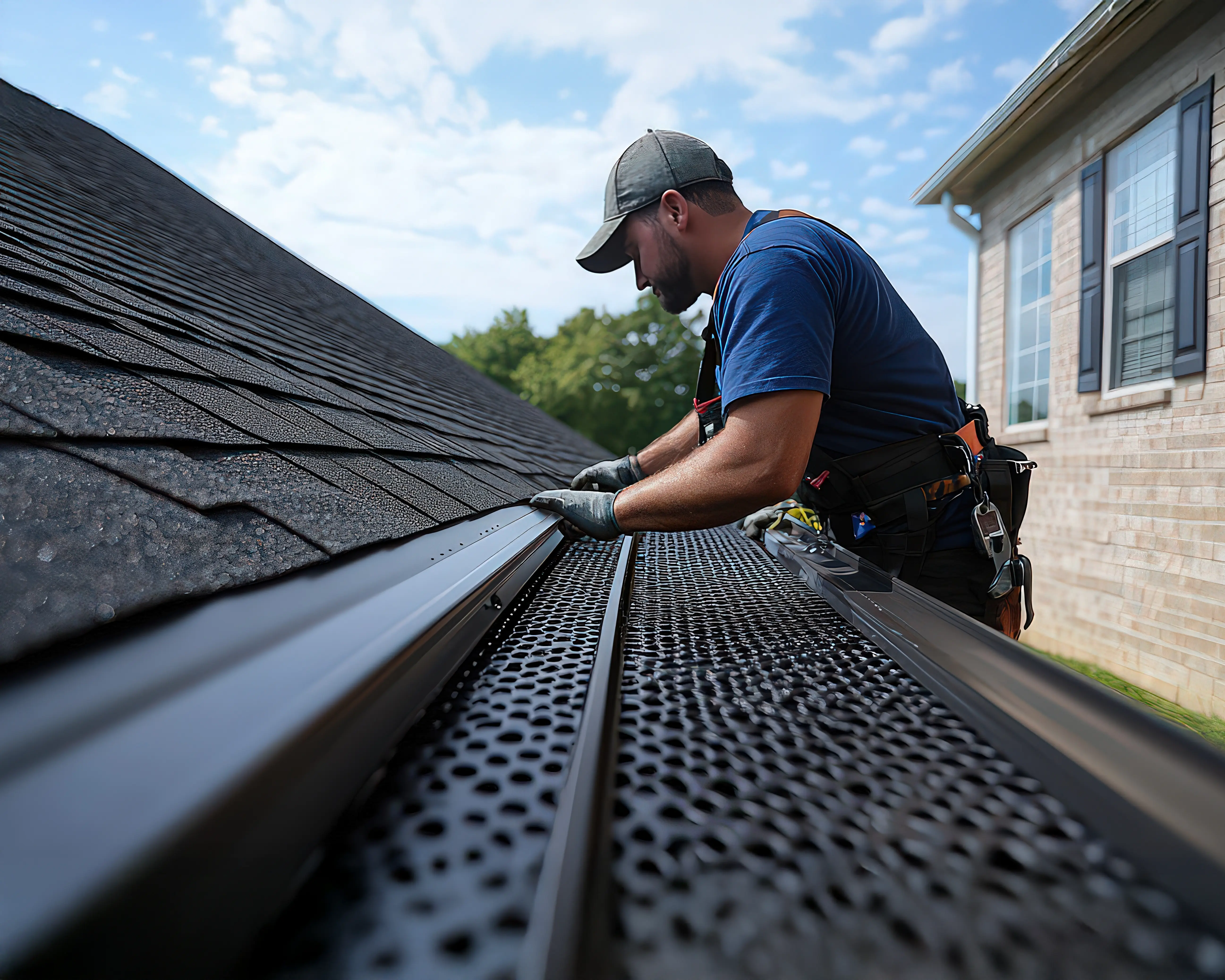
Seamless Gutters, Sized for Your Roof
6" seamless aluminum as our standard — roughly 40–50% more capacity than the 5" gutters most homes were built with — fabricated on site and usually installed in one day.
Most Gutter Replacements Copy the Old Mistake
Gutters are the only thing standing between a heavy Cincinnati rain and your foundation, siding, and landscaping. Yet most replacements never ask whether the original gutters were ever big enough — the installer measures the old run and puts the same size back. Prodigy Home Pros starts with the roof, not the gutter: we calculate how much water your roof actually sheds in a hard rain for your ZIP code, then build a seamless system on site that can carry it. The result is a gutter system that works the way it should for decades, not one that overflows at the same corners the old one did.

Why Cincinnati Homeowners Choose Prodigy Home Pros for Gutters
6" seamless aluminum is our standard, not an upgrade. Many companies quote 5" and sell 6" as a premium add-on. We install the larger profile on every home because it carries roughly 40–50% more water and clogs less.
Catchment calculation on every roof. We measure roof area and pitch and apply local rainfall intensity to size gutters and downspouts for your home — not for the house next door, and not for whatever was hanging there before.
Failure-point inspection, not a glance from the driveway. We inspect the four places most gutter systems actually fail: miters, seams, elbow transitions, and end caps — and tell you plainly whether repair or replacement makes sense.
Fabricated on site, installed in about a day. Each run is roll-formed to length at your home, so there are no mid-run seams to leak. Most homes are complete in a single day.
Dozens of colors. Match your trim to disappear, or choose a contrasting color to sharpen the look of the whole house.
Two warranties, not one. Every system carries the manufacturer's 20-year finish warranty on the aluminum, plus a separate Prodigy workmanship warranty on the installation itself. Terms vary with the options you choose, and we put both in writing before you sign.
Gutter Technical Discussion
The Gap Nobody Explains: "Replace in Kind" Is Not a Design
Here is how most gutter replacement quotes are produced: someone measures the linear feet of gutter already on the house, counts the downspouts, and prices the same thing in new metal. It is fast, and it is why so many "new" gutter systems overflow at exactly the same corners the old ones did.
The old gutters were sized by whoever built the house, often decades ago, usually with the cheapest profile that passed inspection. If a 5" gutter with two downspouts was undersized for your roof in 1995, a brand-new 5" gutter with two downspouts is still undersized today. Replacing in kind copies the original mistake with a fresh coat of paint.
The reality: the right gutter size depends on three things that have nothing to do with the existing gutter — how many square feet of roof drain into each run, how steep that roof is (steeper roofs shed water faster), and how hard it rains in your area during a short, intense storm. Together those determine what we call the catchment rate: the volume of water a gutter and its downspouts must move in the worst few minutes of a storm. When we design your system we run that calculation for your ZIP code, not a national average.

What "Catchment Calculation" Means in Plain Terms
Every roof plane sends its water to one gutter run. We measure that plane's footprint, then multiply by a pitch factor — a flat roof counts as 1.0, while a steep 12/12 roof counts around 1.3 because water arrives at the gutter faster. That gives an effective drainage area. We then compare that area, at local storm intensity, against what each gutter profile and downspout size can actually move:
A 5" K-style gutter typically handles up to roughly 5,500 sq ft of effective drainage area; a 6" K-style handles roughly 7,900 sq ft — about 44% more.
A standard 2×3" downspout drains roughly 600 sq ft of roof; a 3×4" downspout drains roughly 1,200 sq ft — double.
Long runs, inside corners, and low-slope sections need more downspouts, not just bigger gutters.
Those published figures are a starting point. Your roof's actual layout — valleys that dump two planes into one corner, a second-story roof draining onto a first-story gutter, a long run with a single downspout at one end — is what our inspection captures and what the final design solves. The number that matters is the one for your house.

What We Design and Install
6" K-style seamless aluminum gutters, roll-formed on site to the exact length of each run — our standard on every home
Oversized 3×4" downspouts, plus added downspouts on long or heavy-catchment runs where the calculation calls for them
Hidden hangers fastened into the fascia at close spacing so gutters hold pitch under ice and debris load
Fascia and soffit inspection and repair before hanging new gutters — new gutters on rotted wood do not stay up
Factory-finished colors in dozens of options, with a 20-year manufacturer finish warranty — and custom-painted gutters when the color you want is not on the chart
Downspout extensions, splash blocks, and underground drain tie-ins so water leaves the foundation, not just the roof
Gutter guards in a range of styles, matched to your tree cover and roof pitch rather than sold as one package
Removal and haul-away of the old system, with a clean job site the same day
The Decisions You'll Make — and How We Help
Repair or replace? If the failures are isolated to a miter or an end cap on an otherwise sound, correctly sized system, repair may be the right call. If the system is undersized, sagging, or leaking at multiple joints, replacement is the better use of your money. Our inspection report shows you which one you have.
5" or 6"? We make this easy: 6" is our standard. If you have a very small, simple roof we will tell you it does not need more.
Where do the downspouts go? The calculation tells us how many; you help us decide where. We route them to avoid walkways, patios, and the corner you see from the street.
Match or contrast? Color samples are available in the estimate visit. Most homeowners match trim; some choose a darker or bolder color to modernize the exterior. If the exact shade is not on the factory chart, we can custom-paint the system to match.
Where should the water end up? Splash blocks are the minimum. Extensions or buried drains keep water away from foundations, basements, and beds you have already replanted once.
Guards or no guards? Depends on tree cover and roof pitch. We install several guard styles and will recommend the one that fits your yard — or tell you when open gutters are the better value.
Why Our Process Beats "Measure and Match"
Three mechanisms drive most disappointing gutter jobs, and none of them are about the metal.
Measuring the old gutter instead of the roof. The fastest way to quote is to measure what is there. It skips the only question that matters — can this size move this roof's water? — and guarantees the new system inherits the old one's limits.
Selling the right size as an upgrade. Many quotes start at 5" and add 6" gutters, larger downspouts, and extra drops as line items. That packaging makes the correct design look like the expensive option. We start at the size the roof needs, so there is nothing to upsell.
A design that never reaches the installer. In many companies the salesperson measures, a separate crew installs, and the drawing — if there was one — stays in the truck. Whoever is on the ladder decides where downspouts go. At Prodigy the catchment calculation and layout are documented before install day, the crew installs to that plan, and one Prodigy project lead is accountable for the system that ends up on your house.

Our Process
Inspection. We check miters, seams, elbows, end caps, hanger spacing, pitch, and the fascia behind the gutter, then photograph what we find and walk you through it.
Catchment calculation. Roof area, pitch, and local rainfall intensity for your ZIP code determine gutter size, downspout size, and downspout count for every run.
Design and color selection. You see the layout, the downspout locations, and color samples against your actual siding and trim.
Financing options. We work with financing partners across Greater Cincinnati; available plans vary by city, and we walk you through what applies to your address before the proposal.
Fixed-price proposal. One number covering removal, fascia repair if needed, fabrication, installation, extensions, and cleanup — no change orders for things we should have seen.
On-site fabrication and one-day installation. The gutter machine comes to your driveway. Each run is formed to length, hung on hidden hangers, and pitched to drain. Most homes are complete the same day.
Walk-through and warranty. We flush the system, confirm every downspout discharges where planned, and hand you the Prodigy workmanship warranty and the manufacturer's 20-year finish warranty paperwork.
Frequently Asked Questions
How do I know if my gutters need to be replaced? Look for water overflowing the front edge during rain, dripping or staining at corners and end caps, mulch or soil washed out beneath the gutter line, sagging or separated sections, and peeling paint or soft wood on the fascia. Any one of these means water is going where it should not. If the failures are limited to a single joint on a correctly sized system, repair may be enough; multiple leaks, sagging, or chronic overflow usually mean replacement.
Are 6-inch gutters worth it over 5-inch? In most cases, yes. A 6" K-style gutter carries roughly 40–50% more water than a 5" and pairs with larger 3×4" downspouts that clog less. The material cost difference is modest compared to the labor, which is the same either way. Prodigy Home Pros installs 6" seamless aluminum as the standard on every home rather than pricing it as an upgrade.
What are seamless gutters, and why do they matter? Seamless gutters are roll-formed from a coil of aluminum on site, so each straight run is a single piece with no joints along its length. Sectional gutters from a home center are joined every 10 feet, and every joint is a future leak. With seamless, the only joints are at corners (miters) and end caps — which is exactly where we focus our inspection and sealing.
How long does gutter installation take? For most homes, one day. The old system is removed in the morning, new runs are fabricated in the driveway to exact length, and the system is hung, pitched, and flushed by the afternoon. Larger homes or homes needing fascia repair can take a second day.
Do gutters really protect the foundation? Yes. A roof of 2,000 square feet sheds more than 1,200 gallons in a one-inch rain. Without gutters and downspouts that actually carry that volume, the water lands within a few feet of the foundation, saturates the soil, and finds its way into basements and crawl spaces. Properly sized gutters with extensions that discharge several feet from the house are the least expensive foundation protection you can buy.